A bar fridge should help staff find and serve drinks through a busy shift. The right cabinet for a hotel bar may be different from the one needed behind a café counter or in a small restaurant service area.
Use your drinks list and the busiest part of service to work out what needs to be chilled within reach. Then compare the physical layout, installation requirements and operating duty of the shortlisted models.
Start With the Drinks List and Peak Service
List the bottles, cans and mixers that staff need at the bar, including the container sizes and quantities used during your busiest period. Compare shelf spacing, usable depth and the number of products that can be reached comfortably. Gross litres alone will not show how your actual stock fits.
Plan where reserve stock will sit and when the bar can be replenished. A cabinet that holds a useful service quantity can be more practical than a larger unit that obstructs movement or is awkward to restock. For reserve chilled storage, compare the wider Commercial Refrigeration range.

Calculate usable stock, then check the shelf layout
Work from the drinks sold during the busiest period and the time between restocks. For example, 60 bottled drinks and 40 cans between replenishments means planning space for those 100 containers, then adding the separate reserve quantity your venue needs. This is a stock-planning example, not a claim that a particular cabinet holds that mix.
Record bottle heights and diameters, can sizes and the number of facings staff need. Confirm the usable shelf arrangement with the supplier. Door count and gross litres help narrow the search, but neither confirms the number of your specific drinks that will fit.
Compare Doors and Cabinet Formats
| Check | What to confirm |
|---|---|
| Glass or solid doors | Whether staff or customers need to see the drinks, and the cabinet’s specified storage purpose. |
| Hinged or sliding access | The door opening space and how staff pass one another behind the bar. Availability depends on the model. |
| Shelf arrangement | Bottle heights, can formats, shelf adjustment and usable storage depth. |
| Temperature requirements | Suitability for the drinks being stored. Separate doors do not automatically mean independently controlled zones. |
Start with Bar Fridges for beverage-service formats. If customers select packaged drinks directly from a visible cabinet, also compare Display Refrigeration. For a wine-focused requirement, confirm the model’s intended use and temperature capability rather than assuming any drinks fridge will suit.
Check the Bar Position Before Ordering
Measure the supplied cabinet, delivery route and final opening. Allow for door travel, nearby equipment, electrical access and the manufacturer’s ventilation requirements. A cabinet placed beneath a counter still needs its documented air paths and service clearances.
Check the model’s ambient rating against the planned location. Heat from nearby equipment, direct sun or an enclosed recess may change which cabinet is appropriate. Describe the location and the frequency of door openings when requesting advice.
For a customer-facing bar, ask about any published noise information and the intended position of the refrigeration equipment. Consider how staff will access shelves, clean the cabinet and replenish stock without interrupting service.
Compare Energy Use and Ownership Costs
Use comparable energy-consumption data where available, including the stated test conditions. A lower wattage figure on its own does not establish lower daily energy use. The Australian Government’s refrigerated-cabinet guidance explains the commercial product categories and energy information.
Review cleaning instructions, condenser access, warranty conditions and service arrangements. Confirm delivery, placement and installation inclusions so the quote reflects the cabinet ready for its intended location. Do not assume domestic-fridge features or installation arrangements apply to a commercial model.
Shortlist by access, capacity and the bar layout
| Your service need | What to compare | Next check |
|---|---|---|
| A tight staff aisle | Hinged versus sliding doors where available. | Openings, staff passing space and how many drinks are accessible at once. |
| More stock within reach | Two-door versus three-door cabinet formats. | Usable shelving, restocking frequency and the complete cabinet dimensions. |
| Visible drinks selection | Glass-door cabinets and the lighting provided. | Visibility from the working position, shelf arrangement and cleaning access. |
| Storage below a counter | Cabinets intended for the planned position. | The model’s ventilation paths, ambient rating and service clearances. |
For the door-count decision, read Bar Fridge Sizes: Choosing 1, 2 or 3 Doors. Use it alongside this guide to compare the footprint and replenishment pattern before picking the cabinet.

Bromic 118L Back Bar Display Chiller Hinged Door BB0120GD-NR
A compact 118L single hinged-door format. Compare your drink sizes, shelf layout and door opening space, then confirm the model’s installation requirements.

Airex AXR.MEBB.2D 236 Bottle 2 Door Back Bar Fridge
A two-door format with a supplier-stated 236-bottle capacity. Confirm the bottle sizes and shelf layout for your drinks range, and keep the right-hand ventilation panel clear.
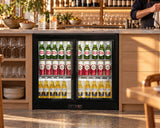
Illustrative café and bar settings. Drinks and surrounding fitout are presentation props.
These are current range examples, not a capacity or installation recommendation for every bar. Confirm suitability for your drinks, location and trading pattern with ICE Group.
Common Questions About Commercial Bar Fridges
Is the largest fridge always the best choice?
No. Compare the service stock you need, shelf layout and replenishment plan with the available space. Extra capacity is useful only if staff can access and restock it efficiently.
Can a bar fridge be installed in an enclosed cabinet?
Only where the selected model’s installation instructions allow it and the required ventilation and clearances are provided. Ask for the installation drawing before finalising cabinetry.
Does every commercial bar fridge suit outdoor use?
No. Confirm the manufacturer’s intended application and installation conditions for the exact model before planning an outdoor or exposed position.
Choose a Bar Fridge for Your Venue
Send ICE Group your drinks list, available dimensions and a photo of the proposed position, or call 02 4228 0100.
Browse Bar FridgesDisplay RefrigerationAsk an Equipment SpecialistRelated reading: 3-door underbench fridge buying guide and SKOPE double-door fridge selection.