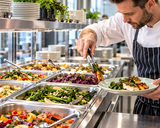
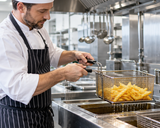
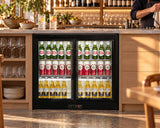
A commercial kitchen equipment checklist should begin with your menu, peak service volume, available space and site services—not a generic shopping list. The right mix of refrigeration, cooking, preparation, warewashing, storage and display equipment should support how food moves through the venue, how many staff work at once and how the business expects to grow.
This Australian buyer’s guide is designed for cafés, restaurants, takeaways, pubs, clubs, hotels, schools, healthcare kitchens, aged-care facilities and food-production businesses planning a new commercial kitchen or replacing existing equipment.
Start with the menu, peak period and production method
Before comparing brands or prices, define what the kitchen must produce during its busiest service window. A café serving a high volume of coffee and a compact breakfast menu has very different requirements from a restaurant running lunch and dinner, a school preparing scheduled meal periods or an aged-care kitchen producing texture-modified food.
Map the menu into practical production tasks:
- Cold storage: chilled ingredients, frozen goods, beverages and prepared food.
- Preparation: washing, cutting, mixing, slicing, portioning and food processing.
- Cooking: grilling, frying, steaming, baking, roasting, boiling or regeneration.
- Holding and display: hot holding, chilled display, grab-and-go merchandising and pass service.
- Cleaning: pot washing, glasswashing, dishwashing and waste handling.
Then calculate demand during the busiest 30 to 60 minutes. Buying only for the average day can create bottlenecks when every docket arrives at once. Buying significantly beyond realistic demand can consume valuable space, power and capital without improving service.
Commercial kitchen equipment checklist
| Kitchen zone | Common equipment | Key buying questions |
|---|---|---|
| Refrigeration | Upright fridges and freezers, underbench units, prep counters, cool rooms, display refrigeration | What storage volume is needed? How often are deliveries received? Will doors and drawers remain accessible during service? |
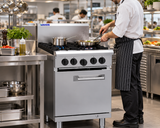
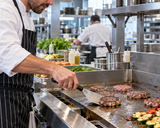
| Cooking | Ranges, ovens, combi ovens, fryers, griddles, chargrills, induction, pasta or noodle cookers | Which menu items share equipment? What recovery rate is required? Are gas, electric, water and extraction available? |
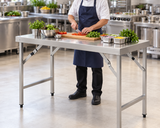
| Preparation | Stainless benches, mixers, slicers, food processors, blenders, vacuum packers, scales | Can preparation be completed safely without crossing cooked and raw-food workflows? |
| Warewashing | Underbench or pass-through dishwashers, glasswashers, sinks, pre-rinse units, drying racks | How many racks are needed per hour? Is there adequate hot water, drainage, ventilation and landing space? |
| Storage | Dry-store shelving, mobile racks, ingredient bins, wall shelves, dunnage racks | Can stock be rotated, inspected and cleaned around easily? |
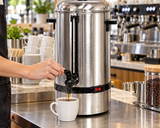
| Display and service | Heated displays, refrigerated displays, bain-maries, pie warmers, coffee equipment | Does the equipment improve visibility and speed without obstructing customer or staff movement? |
| Safety and hygiene | Handwash basins, splashbacks, fire-safety provisions, floor mats, thermometers | Can staff clean, monitor and maintain the area efficiently? |
Explore ICE Group’s commercial cooking equipment range when comparing the core appliances for your menu.
What equipment does each venue type usually need?
Cafés and coffee shops
A café equipment list commonly centres on a commercial espresso machine, grinders, underbench milk refrigeration, display cabinets, a dishwasher or glasswasher, a compact oven, sandwich press, griddle and food-preparation equipment. The exact mix depends on whether the venue is primarily beverage-led, offers all-day breakfast or produces a larger lunch menu.
See equipment and planning ideas for cafés and coffee shops.
Restaurants and takeaways
Restaurants normally require a stronger hot line, greater cold storage, dedicated preparation zones and higher-capacity warewashing. Takeaway businesses may prioritise fryers, griddles, noodle cookers, hot holding, packaging workflow and fast order assembly. Menu engineering is critical: every appliance should support enough profitable dishes to justify its footprint.
Review solutions for restaurants and takeaways.
Hotels, pubs and clubs
These venues often need flexible equipment capable of handling multiple dayparts, functions and high-volume periods. Combi ovens, heavy-duty cooking lines, bulk refrigeration, ice machines, glasswashers and pass-through dishwashers may form part of a broader production system.
Schools, healthcare and aged care
Institutional kitchens usually place greater emphasis on repeatable batch production, safe food handling, scheduled service, easy cleaning and dependable support. Equipment selection should consider staff capability, menu cycles, special dietary requirements and how food is transported or regenerated.
ICE Group has dedicated guidance for schools and education and healthcare and aged care.
Confirm power, gas, water, drainage and ventilation before ordering
A commercially suitable appliance can still be the wrong purchase if the site cannot support it. Before placing an order, record the exact requirements for every item and have the relevant trades confirm the proposed location.
- Electrical supply: plug type, amperage, voltage, phase and available circuit capacity.
- Gas: natural gas or LPG, connection requirements and available supply.
- Water: inlet location, pressure, filtration and water-treatment requirements.
- Drainage: waste connection, fall, tundish or floor-waste requirements where applicable.
- Ventilation: heat, steam, grease-laden vapour and manufacturer clearances.
- Access: doorway widths, stairs, lifts, loading zones and final positioning.
Do not assume that a replacement appliance is a direct swap simply because the external dimensions look similar. Service points, clearances, electrical load and ventilation requirements can differ between models.
Design the workflow before filling the room
A productive commercial kitchen usually follows a logical sequence: receiving, storage, preparation, cooking, plating or service, then washing and waste removal. Staff should not need to carry hot pans through a dishwashing zone or cross a busy cooking line to reach refrigeration used every few minutes.
Useful questions include:
- Can deliveries reach storage without passing through active food preparation?
- Are frequently used ingredients within easy reach of the relevant station?
- Can two staff pass safely during peak service?
- Is there landing space beside ovens, fryers and dishwashers?
- Can service technicians access panels and components without dismantling surrounding joinery?
- Is there room to clean behind, beneath and around equipment?
For new venues and refurbishments, review ICE Group’s commercial kitchen and hospitality projects to see how equipment, stainless fabrication and workflow can be coordinated as one system.
Essential equipment versus equipment that can be added later
Separate the equipment list into three groups:
- Opening-day essentials: the equipment required to produce the core menu safely and reliably.
- Capacity upgrades: items that become necessary when volume reaches a defined trigger.
- Menu expansion: specialist equipment linked to a future product range or service period.
This protects cash flow and floor space while preventing the kitchen from becoming boxed in. Allow utility capacity and physical room for planned upgrades where possible.
Compare total cost of ownership, not only purchase price
The lowest initial price is not always the lowest-cost decision. Consider the complete operating picture:
- Expected utilisation and production capacity
- Energy and water requirements
- Cleaning chemicals and consumables
- Labour required to operate and clean the equipment
- Warranty conditions and service access
- Availability of parts and trained technicians
- Downtime risk if the appliance is critical to the menu
- Potential resale or redeployment value
Preventive maintenance should also be budgeted from the beginning. ICE Group provides commercial equipment servicing and repairs, helping operators plan support beyond the initial sale.
Should you buy, rent or finance commercial kitchen equipment?
The appropriate funding approach depends on business stage, available capital, equipment life and how certain you are about future demand. Some operators purchase core equipment and use a flexible funding solution for growth items. Others prefer to preserve working capital during a fitout.
Review ICE Group’s Rent-Try-Buy information and obtain independent financial advice before committing to a funding structure.
Final commercial kitchen equipment pre-purchase checklist
- The menu and peak production target are documented.
- Equipment capacity has been checked against the busiest service period.
- Dimensions include doors, handles, ventilation gaps and service access.
- Power, gas, water, drainage and extraction have been confirmed.
- Delivery access and final positioning have been checked.
- Benches, stands, shelves and landing areas are included.
- Cleaning procedures and consumables are understood.
- Warranty, servicing and spare-parts support have been reviewed.
- The equipment list fits the workflow—not just the available wall space.
- Future growth has been allowed for without overcapitalising on day one.
Work with a commercial kitchen equipment supplier that can support the whole project
ICE Group supplies commercial kitchen equipment across Wollongong, the Illawarra, Sydney and wider NSW, with support spanning equipment selection, complete kitchen fit-outs, stainless-steel fabrication, installation coordination and ongoing servicing. That end-to-end capability helps reduce the gaps that can occur when design, equipment and after-sales support are handled separately.
Planning a new venue or equipment upgrade? Browse commercial cooking equipment, view completed projects or contact ICE Group for practical advice and a tailored quote.