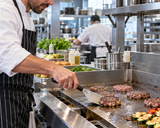
Breakfast starts with eggs, mushrooms and tomatoes. By lunch, the same stretch of steel may be turning out burgers while the pass waits for the next order. A griddle earns its place through useful working area, controllable heat and a layout the cook can manage when tickets arrive together.
Choosing a gas or electric commercial griddle starts with your menu and the services available at the site. Fuel type matters, but it does not describe the whole machine. This guide looks at plate area, controls, installation and the practical differences between the models Australian hospitality operators are likely to compare.

Start with the food that needs the plate
A flat griddle gives food direct contact with a heated cooking surface. It is a different category from a chargrill, a hinged contact grill or a salamander. Those appliances have different cooking actions, so they should not be treated as automatic substitutes when planning a menu.
List what must cook at the same time. Include the footprint of each portion, room for a spatula, space for turning and any need to keep different tasks apart. A breakfast station with several components can need more usable plate area than a menu with one repeated item.
The Fryers & Griddles category is the starting point for equipment. This guide concentrates on open flat-plate griddles; use the separate fryer capacity and recovery guide when the task calls for deep frying.
Gas vs electric: compare the site as well as the appliance
| Decision | Gas griddle | Electric griddle |
|---|---|---|
| Available services | Confirm gas type, supply and the model's connection requirements. | Confirm electrical load, phase, circuit and connection requirements. |
| Heat control | Check the actual burner zones and controls supplied. | Check the actual thermostatic zones and controls supplied. |
| Kitchen fit | Allow for the appliance format, clearances and service access. | Allow for the appliance format, clearances and service access. |
| Installed cost | Include relevant gas work, extraction and commissioning. | Include relevant electrical work, extraction and commissioning. |
Neither fuel label establishes the winner for every venue. Compare machines with a similar cooking task and useful surface area, then check installation and operating costs against your own site and tariffs. Do not assume that an electric model is portable or plug-in, or that every gas model can be supplied for either gas type without confirmation.
Usable plate area is more helpful than cabinet width
The outside width includes the appliance body. The published cooking surface describes the area available for the food, and the usable working area still needs room for handling and separation between tasks.
For example, Roband lists a 515 × 340mm cooking surface for the G500 and 700 × 400mm for the G700. That extra area creates a different workstation; it is not a promise of a particular number of burgers per hour.
Sketch a busy order using your actual portion sizes. Mark where eggs, vegetables or proteins will sit and how the cook will turn them. Then consider recovery: how the plate responds when cold food is added and how the available zones support the next order. Plate construction, installed power, controls, food load and operating method all belong in that discussion.
Ask for a demonstration or model-specific performance information where output is critical. A generic claim that one fuel is always faster is not enough to specify a kitchen.

Plan the cooking line, extraction and cleaning together
Check the complete appliance footprint, including any projecting grease box, controls and required clearances. Leave a practical landing area beside the plate and a route for food to reach the pass. A griddle squeezed into an unusable corner can slow the station even when its cooking surface is large.
Arrange a site check with the appropriate installer. Electrical and gas requirements are model-specific, and extraction must be considered for the actual cooking process and site. Roband states that its G700 requires installation by a licensed electrician and is supplied without a plug and cord; it should not be planned as a standard plug-in bench appliance.
For everyday cleaning, look at grease collection, splashback design, access beneath and around the appliance, and the manufacturer's approved cleaning method. Match cleaning tools and products to the specified plate finish. Budget staff time for that routine as part of the equipment decision.
A useful gas-and-electric shortlist
| Model | Starting point | Question to resolve |
|---|---|---|
| LUUS CS-6P | 600mm commercial gas griddle format. | Confirm gas type, current plate specification and the supplied configuration. |
| Roband G500 | Electric countertop model; 515 × 340mm cooking surface and a listed 10A requirement. | Does its working area and output suit the busiest menu period? |
| Roband G700 | Larger electric surface at 700 × 400mm with dual control. | Confirm the electrician's connection design and available bench footprint. |
These are different formats, not a like-for-like performance ranking. Use them to establish the specification, then compare alternatives against the same menu, working area and site requirements. The manufacturer's current G500 and G700 control arrangements should be checked individually rather than assumed to be identical.
Common commercial griddle questions
Is gas or electric better for a busy café?
Choose by menu, working area, model performance and site services. Compare specific appliances and the installed cost rather than relying on fuel type alone.
Does an electric griddle need a special circuit?
Requirements vary. Check the exact model's load, phase and connection instructions with an electrician before purchase.
Is a contact grill the same as a flat griddle?
No. A contact grill has a different cooking action and can suit different tasks. Specify the food and service workflow before choosing the appliance type.
Choose the workstation your menu needs
A good shortlist connects three things: what must cook together, the area the cook can actually use and the services the kitchen can support. Resolve those first and the gas-or-electric decision becomes more practical.
Check your griddle specification
Compare cooking equipment, review the model examples above, or send ICE Group your menu, bench dimensions and site services.
Sources and specification checks
Reviewed 21 October 2026. Photographs illustrate commercial cooking workflows and do not identify the listed models. Confirm current model specifications and installation requirements before purchase.