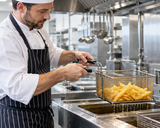
The fryer rarely receives its orders one at a time. A run of burger meals can be followed by fish, calamari and another table's chips before the first baskets have drained. The useful question is how the station performs through that concentrated demand, not simply how many litres appear on the specification sheet.
A commercial fryer shortlist should connect peak portions, product mix, tank arrangement, recovery and site services. This guide focuses on choosing equipment for Australian cafés, restaurants and takeaway kitchens. For the wider cooking and oil-care discussion, read Deep Frying for Better Restaurant Service.

Measure the busiest service period
Start with the volume that reaches the fryer during the busiest realistic window. Count portions, record the weight of each portion and separate the products with different cooking times or handling needs. Daily sales are useful background, but they can hide a short rush that determines the equipment requirement.
| Planning input | Illustrative figure |
|---|---|
| Chip portions in the busiest 30 minutes | 60 |
| Uncooked portion weight | 150g |
| Food through the fryer in that window | 9kg |
| Equivalent hourly rate for that window | 18kg per hour |
This is an arithmetic example, not a fryer recommendation or an equipment output claim. It excludes other products and says nothing about the cooking time, batch limit or recovery of a particular model. It also does not mean 9kg can be loaded together. Use your own portions and order pattern, then ask the supplier to assess the model under comparable conditions.
Tank litres and recovery answer different questions
Oil capacity describes the tank's working oil volume. Basket dimensions describe what physically fits. Neither figure, on its own, establishes how much finished food the station can produce during a rush.
Recovery describes how the fryer responds after a load reduces the oil temperature. Compare the manufacturer's permitted batch loads, control system, heating capacity and any tested production data. Keep the test conditions alongside the figure: frozen and thawed product, food size, cooking method and the standard used to judge a finished batch can change the comparison.
- Ask for the intended food, starting temperature and batch weight behind any kg-per-hour claim.
- Check the specified oil fill range and basket configuration.
- Plan loading, cooking, draining and plating as a complete cycle.
- Allow for the other items sharing the station during the same period.
A larger basket is not permission to exceed the manufacturer's load instructions. If recovery is the bottleneck, simply adding more food can make the service problem worse. Compare models against the job described in your demand brief.
One tank with two baskets is different from two tanks
Two baskets above one tank still share the same oil. Independent tanks provide a different operating arrangement: staff can stagger batches, use separate settings where the equipment permits, or allocate different foods to different oil circuits.
| Format | Useful planning question | Do not assume |
|---|---|---|
| Single tank | Can one cooking process handle the peak product mix? | That basket count equals independent frying capacity. |
| Independent twin tanks | Would separate batches or oil circuits improve the workflow? | That two tanks automatically double practical output. |
| Larger floor model | Does service demand justify the footprint and services? | That a bigger oil volume removes recovery or handling limits. |
Where allergens are involved, equipment layout is only one part of the control. Separate oil, utensils, storage, preparation and staff procedures need consideration; a second basket in shared oil is not segregation, and a second tank alone is not a guarantee against cross-contact.

Include power, extraction and cleaning in the brief
Check gas or electrical supply for the exact model before settling on a format. Countertop fryers can require more than a standard bench power point, and twin-pan equipment may need separate connections. Larger electric floor models can require three-phase supply.
Measure the installed footprint and plan basket lifting, draining and transfer to the pass. Leave practical access for cleaning and servicing. Discuss extraction and the installation with appropriately qualified trades for the actual site and cooking process.
Also decide how staff will manage crumbs, filtration, draining and oil changes according to the manufacturer's instructions. Removable tanks and drains create different end-of-service routines. Cleaning access and a manageable handling process belong in the purchasing decision, not in a workaround after installation.
Three formats from the ICE Group range
| Model | Verified format | Check before choosing |
|---|---|---|
| Roband F18 | Single 8L countertop pan. | Permitted batch load, product mix and the listed 15A supply requirement. |
| Roband F28 | Two independent 8L countertop pans. | Separate-pan workflow and the listed two 15A connections. |
| Austheat AF812R | Single 33L floor-model tank with two baskets and a rapid-recovery feature. | 16.7kW electrical requirement, three-phase supply, footprint and model-specific output. |
These examples demonstrate different layouts and service requirements. They are not an output ranking, and none should be selected from litres alone. Use the commercial fryer and griddle range to compare alternatives once the demand and site brief is clear.
Common commercial fryer questions
What size commercial fryer do I need?
Start with peak portions, product weight and the timing of orders. Compare permitted batch loads and recovery with the supplier, then confirm tank layout and site services.
Does a twin-basket fryer have two independent tanks?
Not necessarily. Check the number of oil tanks and controls. Two baskets can sit over one shared tank.
Can I compare fryers by litres alone?
No. Oil capacity must be considered with heating, controls, basket configuration, tested production information and the complete service cycle.
Should I use a fryer or a griddle?
They perform different cooking tasks. For direct flat-plate cooking, see the gas vs electric commercial griddle guide.
Bring the rush into the equipment decision
Choose around the busy period the team must handle reliably. A clear brief records portions, food types, tank separation, available services and cleaning access. That gives the supplier something more useful to work with than a preferred basket size.
Plan a fryer station that fits your service
Browse the equipment range, revisit the model examples, or ask ICE Group to review your peak-demand and site brief.
Sources and specification checks
Reviewed 21 October 2026. The demand calculation is illustrative. Photographs show generic commercial frying workflows; confirm exact model specifications, instructions and site requirements before purchase.