Commercial refrigeration buying guide · ICE Group (Aust)
A well-sized bar fridge puts the right drinks within reach through the busiest part of service. Too little usable storage means repeated trips to replenish stock; a cabinet that overwhelms the bar can take away valuable working space.
This guide helps Australian cafés, restaurants, pubs and clubs compare one, two and three-door bar fridges by stock demand and physical fit. For the broader buying checklist, see our commercial bar fridge buying guide, or browse the Bar Fridges range.

1. Size the bar fridge around stock between restocks
Start with your busiest planned service period and when someone can realistically replenish the cabinet. Total daily drink sales alone will not tell you how much stock needs to be at the bar at one time. A small drinks station with frequent replenishment has different needs from a bar that must cover a long rush without a stock run.
A useful planning calculation is: working stock = expected sales before the next replenishment + your chosen buffer. Break that number into actual bottle and can formats so the fastest sellers get the space they need.
Suppose you expect to sell 40 waters, 20 soft drinks and 20 bottled beers before the next restock: 80 units. Adding an illustrative buffer of 20 brings the working target to 100 units. Test those exact containers against the proposed shelf layout. The buffer is your operating decision; 100 units does not mean 100 litres or prove that a particular fridge will fit them.
Also plan where replacement stock will be chilled. Loading warm drinks during a rush adds a different demand from transferring already chilled stock. Ask about the proposed model’s intended operating conditions and recovery performance for your service pattern.
2. Compare one, two and three-door bar fridges
Door count is a useful way to organise a shortlist, but it is not a universal size standard. Cabinet depth, shelf positions and refrigeration components all affect usable storage. Compare exact models in each format.
| Format | When to consider it | What to check |
|---|---|---|
| 1-door bar fridge | A compact café drinks station, a short packaged-drinks list or a separate service point. | Whether your fastest sellers fit together without crowding the shelves; frequency of replenishment. |
| 2-door bar fridge | A broader drinks mix that benefits from separate water, soft drink and beer zones. | Hinged versus sliding access, shelf allocation and clear space for staff working alongside each other. |
| 3-door bar fridge | A longer backbar with a larger chilled selection or more stock held at the service point. | Total installation width, delivery access and whether one long cabinet serves the workflow better than two smaller stations. |
Two smaller fridges may place drinks closer to separate service points. One larger cabinet may make stock easier to consolidate. Compare the full installed footprint, electrical requirements and running costs of the actual alternatives before deciding.
3. Measure more than the opening under the bench
Record the available width, height and depth in millimetres, then check the manufacturer’s dimensions and installation instructions for the exact model supplied. An underbench position does not automatically make a freestanding fridge suitable for a tightly enclosed cabinet.
- Ventilation: allow the specified clearances and keep airflow paths accessible. Do not assume a visible front grille removes every side or rear clearance requirement.
- Door movement: mark the full swing of hinged doors and handles. Sliding doors avoid a hinged door swinging into the aisle, but check how much of the opening is accessible at once.
- Bench height and levelling: account for the feet, floor level and the space needed to position the unit correctly.
- Depth and services: allow for the plug, cable and any projections identified in the installation drawing; leave access for service and cleaning.
- Delivery route: check entrance doors, turns, stairs and the supplier’s packaged dimensions before arranging delivery.
There is no single standard bar fridge height. If the bar joinery is still being designed, select the equipment and confirm the installation requirements before the opening is finalised.

4. Check usable shelf fit before comparing litres
A stated litre capacity does not show how your drinks menu will sit on the shelves. Tall mineral-water bottles, standard beer bottles and cans need different clear heights. Ask for the internal dimensions, shelf adjustment range and any stated bottle-capacity assumptions.
Sketch the shelf plan with your actual stock mix. Put the highest-volume lines in easy reach, allow the airflow required by the instructions and check whether dividers, door frames or the internal floor shape reduce the space you expected to use. A published bottle count based on one container size is not a guarantee for a mixed drinks list.
Check the stated ambient operating range against the proposed location, especially beside heat-producing equipment or in a warm backbar. For milk, garnishes or other food ingredients, confirm the cabinet is suitable for that intended use and the required storage conditions; do not infer suitability from a glass door or a temperature display.
5. Compare current options in the ICE Group range
These examples give you a starting point for comparing formats. Confirm the current Australian model code, specification, stock and installation requirements with ICE Group before ordering.
- Polar G-Series single-door stainless-steel bar cooler: a one-door format to assess for a compact drinks station.
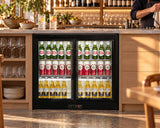
- Polar GL010-A two-door sliding back bar cooler: a format to compare where a hinged door swing would interrupt the aisle.
- Polar G-Series 330L three-door hinged bar cooler: a wider option to assess for a longer backbar and a broader drinks mix.
For illustration, Polar’s published GL007 specification lists a width of 600 mm, while its GL004 specification lists 1,350 mm. Those are cabinet widths for those named models, not installation-opening recommendations or standard widths for every one-door and three-door fridge. Confirm the exact supplied model and required clearances.
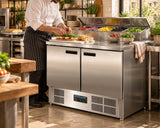
If your main requirement is kitchen ingredient storage, compare the Commercial Refrigeration range rather than assuming a drinks-display cabinet suits the job.
Bar fridge sizing: common questions
What size bar fridge do I need for a café?
List the chilled drinks you expect to sell before the next practical restock, add a buffer you can justify, and check those containers against the shelf plan. Then compare the cabinet and clearance requirements with the space available.
Is a double-door bar fridge always twice the capacity of a single-door model?
No. Compare the stated capacity and usable internal layout of the exact models. Door count alone does not account for cabinet depth, components or shelf positions.
Are sliding doors better for a narrow bar?
They can help where a hinged door would swing into the working aisle. Check opening access, cleaning access and staff workflow as well as the saved swing space.
Can I install a bar fridge tightly under a bench?
Only if the exact model’s installation instructions permit that arrangement. Check ventilation clearances, ambient conditions, service access and the bench opening before ordering or finalising joinery.
Should I choose the largest bar fridge that fits?
Choose the layout that supports your stock and service plan. Extra storage can be useful, but it also occupies space. Compare practical shelf use, replenishment, staff access and the costs of the models being considered.
Find a bar fridge that fits your service
Send ICE Group your available width, height and depth, a photo of the bar position, your drinks list and your expected restock interval. We can help compare current models and confirm the details before you order.
Browse Bar Fridges Call 02 4228 0100Manufacturer references: Polar GL007 specifications and Polar GL004 specifications, checked 17 October 2026. Product details can change; confirm the specification for the model supplied.