Commercial Coffee Machine Installation: Water Filtration, Power & Maintenance
- Oct 05, 2026
- 0 Comments
A commercial espresso machine can be the most visible piece of equipment in a café, but most installation failures happen around it: the bench is too tight, the circuit is wrong, filters cannot be reached, hoses are trapped behind joinery or the grinder and milk station have nowhere sensible to go.
This guide covers the site and maintenance decisions café owners should resolve before a commercial coffee machine arrives.

Plan the site before ordering
Use installed dimensions, not only cabinet dimensions. The machine needs enough space for steam wands, portafilters, cup handling, hoses, drainage, water treatment and future service access.
Record:
- available bench width and depth;
- working clearance on both sides of the machine;
- bench load capacity;
- grinder and knock-box positions;
- milk refrigeration and jug storage;
- cup, takeaway-lid and cleaning-supply locations;
- delivery path to the final position;
- access for technicians after the joinery is complete.
Confirm the electrical supply
Commercial espresso machines can have very different electrical requirements, even within the same group size. Check the selected model documentation before ordering and have the proposed supply confirmed by an appropriately qualified person where required.
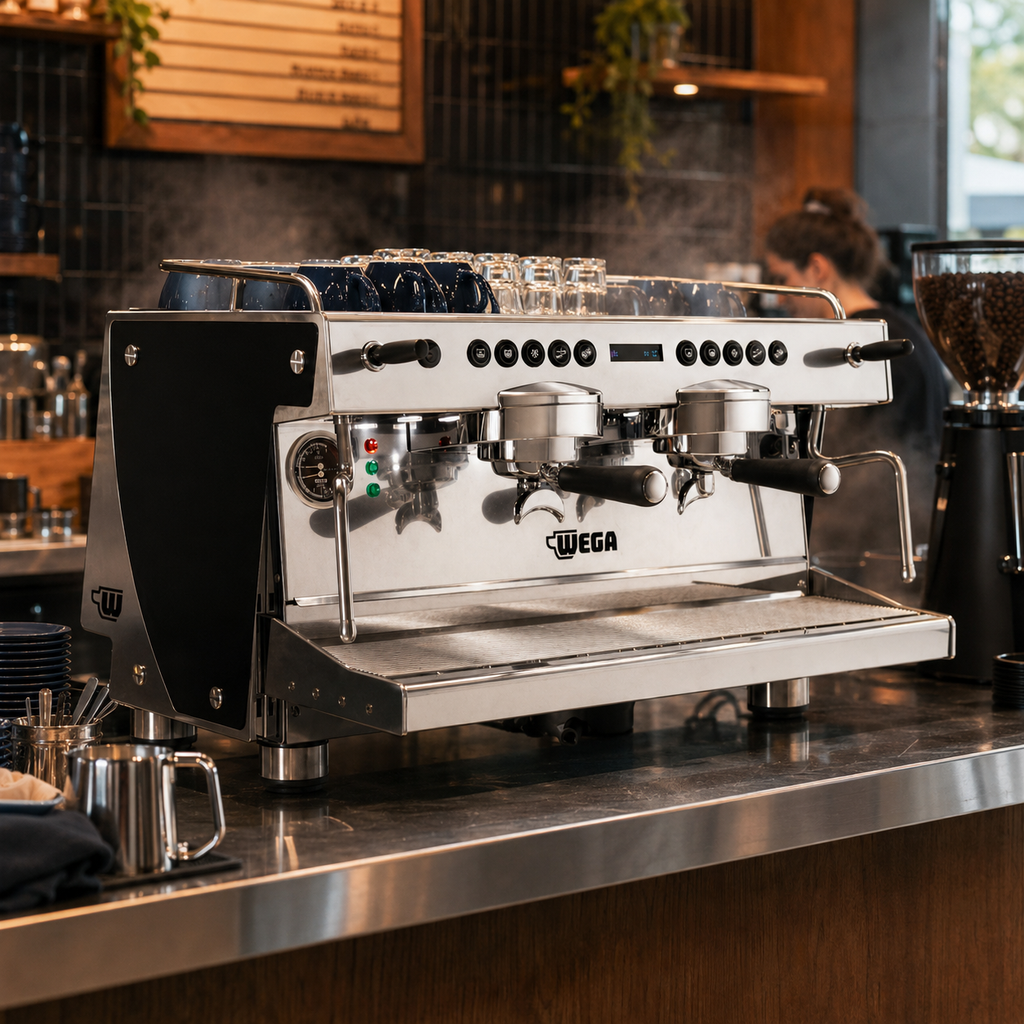
As one real ICE Group example, the current Wega Rover 2 Group buyer’s guide lists a 240V 20A requirement for that specific JC459 model. That requirement should not be assumed for other machines.
See the Wega Rover 2 Group buyer’s guide for the full model example.
Water quality and filtration
Water treatment should be specified for the actual site and machine. Water chemistry affects taste, scale exposure and the machine’s internal water circuit. One universal filter is not the right answer for every venue.
Confirm:
- potable water supply and pressure requirements;
- manufacturer water-quality guidance;
- appropriate filtration or treatment for the local water;
- filter location and replacement access;
- a documented cartridge or treatment-maintenance schedule.
Filters hidden where staff cannot reach them have a habit of becoming permanent archaeological exhibits. Give them service access from day one.

Plumbing and drainage
Confirm both the water connection and waste route before the machine arrives. The selected model may require a permanent water supply and a suitable drain position. Avoid routing services where they are pinched by cabinets or inaccessible for maintenance.
The coffee station should also allow staff to manage rinse water and day-to-day cleaning without creating a wet or congested work area.
Design the full coffee station
| Station element | Planning question |
|---|---|
| Espresso machine | Does the machine fit with working and service clearance? |
| Grinders | Can the grinder capacity keep up with peak espresso production? |
| Milk refrigeration | Can baristas reach milk without crossing another staff member’s path? |
| Tamping / knock box | Is there a stable, efficient prep and waste position? |
| Cups and takeaway packaging | Are the highest-use items within reach but out of the working path? |
| Water treatment | Can the filters be inspected and replaced without dismantling joinery? |
| Service access | Can a technician reach the machine when the venue is fully fitted out? |

Daily cleaning and preventative maintenance
Build the cleaning procedure around the manufacturer’s instructions and the venue’s actual operating pattern. Typical responsibilities can include group heads, baskets, portafilters, steam wands, drip trays and the surrounding work area, but use the approved process for the selected machine.
Also maintain:
- water-treatment replacement records;
- daily and periodic cleaning records;
- notes on pressure, temperature, noise or performance changes;
- planned preventative servicing where appropriate;
- clear access for technicians and spare parts.
ICE Group provides commercial equipment servicing and repairs for venues planning ongoing equipment support.
Coffee-machine installation handover checklist
- Confirm the installed machine matches the approved model and specification.
- Verify the electrical, water and drainage connections against the documentation.
- Record filter type and replacement schedule.
- Confirm the grinder setup and coffee-station layout are ready for service.
- Keep operating and cleaning instructions accessible to the venue team.
- Assign daily cleaning responsibility.
- Record service contact details before the first breakdown, not during it.
Planning a commercial coffee-machine installation?
Choose the machine and grinder together, confirm the site services, then make sure the finished station can actually be cleaned and serviced.
Browse coffee machines → Compare grinders → Discuss your coffee setup →Explore the Commercial Coffee Machine Guides
- 2 Group vs 3 Group Commercial Coffee Machines
- Commercial Espresso Machine Features That Actually Matter
- Installation, Water Filtration, Power & Maintenance
- Wega Rover 2 Group Buyer’s Guide
Frequently asked questions
Does every commercial coffee machine need plumbing?
Requirements vary by model. Confirm the selected machine documentation rather than assuming the same water and drainage setup applies to all commercial espresso machines.
What water filter does a commercial coffee machine need?
The appropriate treatment depends on the machine, manufacturer guidance and local water characteristics. Specify filtration or treatment for the actual site rather than selecting a generic cartridge.
How much space should I leave around the machine?
Allow the machine’s installed dimensions plus the working, ventilation and service clearances specified for the selected model and the surrounding coffee-station layout.
How often should a commercial espresso machine be serviced?
Use the manufacturer’s maintenance guidance and the machine’s workload as the starting point. The venue should also address performance changes promptly rather than waiting for a complete failure.
Reviewed 5 October 2026 · Martin Costanzo · ICE Group Hospitality

Recent Posts
-
-
-
Hoshizaki vs Bromic vs Brema: Comparing Commercial Ice Machines
October 05, 2026
-
-
-
-
Undercounter vs Modular Ice Machines: Which Setup Fits Your Venue?
October 05, 2026
-