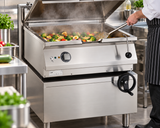
A bratt pan cooks directly in a large, heated pan that tilts to assist emptying. It can suit repeated batches of suitable menu items, while a stockpot boiler heats a separate pot. Choose around the food, working batch size and handling process before choosing gas, electric or a catalogue capacity.
In a production kitchen, the useful question is how the next batch will move through service. A bigger pan can create more output, but the team still needs space to load, stir, empty, clean and move the finished food.

What is a bratt pan used for?
A suitable tilting pan can support tasks such as shallow frying, braising, simmering and batch cooking. Check the intended applications and instructions for the exact model and recipe. Cooking surface, temperature control, mixing and recovery all affect what works well in practice.
Keep it distinct from a stockpot boiler. A bratt pan has its own cooking vessel; a boiler supports a separate compatible pot. An ordinary stockpot is cookware. Those three products should not be treated as interchangeable because they appear in one range.
How do you choose bratt-pan capacity?
Record the quantity you actually cook at once, the batches needed over the production window and how much working space the recipe needs. Compare the manufacturer’s usable capacity with the catalogue description. Maximum vessel volume is not automatically a sensible batch size for every ingredient.
The Zanussi 372356 is listed as a 60L electric tilting bratt pan, with a stated usable well capacity of 50L. That distinction makes a practical difference when comparing an equipment schedule with a recipe sheet.
Check the pan surface as well as volume. A batch that needs contact with the heated surface should be assessed differently from a liquid-based recipe. Allow time for loading, recovery, cooking, emptying and cleaning rather than dividing the service requirement by pan litres alone.
Should you choose gas or electric?
| Compare | Gas | Electric |
|---|---|---|
| Supply | Confirm natural gas or LPG and the required connection for the quoted model. | Confirm voltage, phase, circuit and connection. Some models require three-phase supply. |
| Performance | Compare the exact model’s heating system, controls and recovery for your recipe. | Make the same comparison using the exact electric model and operating conditions. |
| Site | Include ventilation, access and installation work in the quote. | Include electrical work, ventilation, access and installation in the quote. |
There is no useful universal winner without a menu and a site brief. Compare the installed cost and suitable operating data on the same basis. A rated electrical load is not the same as daily electricity consumption.
Which current models illustrate the options?
- Zanussi 372356: electric tilting-pan example, 800 × 700 × 850mm, listed with 9.5kW and 3N supply. Check the quoted Australian configuration.
- Cleveland SGL30TR-NG: a 120L natural-gas tilting-pan example. Confirm the required working load, services and current lead time.
- LUUS FSP-45: a separate-pot boiler example, listed for pots up to 450mm diameter. Specify the gas configuration and check pot handling.
These examples demonstrate different formats and capacities, rather than a like-for-like performance ranking. Start with the bratt-pan and stockpot-boiler range, then compare models suited to the same job.
What should you include in your equipment enquiry?
Send the menu, actual batch size, production frequency, available dimensions, current services and delivery route. Include how food will be transferred from the pan and where staff will stand. Confirm the lid, tilt clearance, controls, cleaning access and whether any supporting items are included.
Use the Food Cost & Overheads Calculator for the wider operating picture. Equipment selection still needs its own batch and site assessment.
Common bratt-pan questions
Is a stockpot boiler a smaller bratt pan?
No. It heats a separate vessel and needs a suitable pot and handling process. Choose the format around your cooking task.
Does the largest capacity offer the best value?
Compare usable capacity, recipe performance and the complete handling cycle. A pan that cannot fit the site or be used efficiently can be the wrong purchase at any size.
Can ICE Group help shortlist models?
Send your batch and site brief to ICE Group or call 02 4228 0100. We can help compare the current range and installation questions.
References: current linked ICE product specifications; LUUS stockpot-boiler formats. The 372356 figures above refer to its current ICE listing.
Prepared 24 October 2026 · Martin Costanzo · ICE Group Hospitality. Confirm the current Australian specification, supplied configuration and site requirements before ordering.